
HPBLUP

Prediction of genetic merit using pedigree and genomic information

HPBLUP

HPBLUP is a modern genetic evaluation system for any animal or plant breeding application.

It estimates genetic merit of individuals or inbred lines using phenotypes and genetic similarities, given the components of variance. Breeders and breeding organizations use estimated genetic merit to identify the most suitable individuals in a generation to become parents of the next generation, or to identify the best crosses of highly inbred lines, recombinant inbred lines or double haploids. HPBLUP supports estimation of effects of genomic dominance and epistasis. HPBLUP offers potential to accelerate genetic progress in your breeding program.

HPBLUP is easy to use, fast, suitable for simultaneous analysis of a large number of traits and able to fit complex models. It supports a wide range of methods to specify genetic similarity between individuals, such as pedigree relationships, genomic relationships, and regression on SNP genotypes.

HPBLUP also offers tools to improve the genetic evaluation and verify that estimated genetic merit is indeed a good prediction of future phenotypes.

Outputs
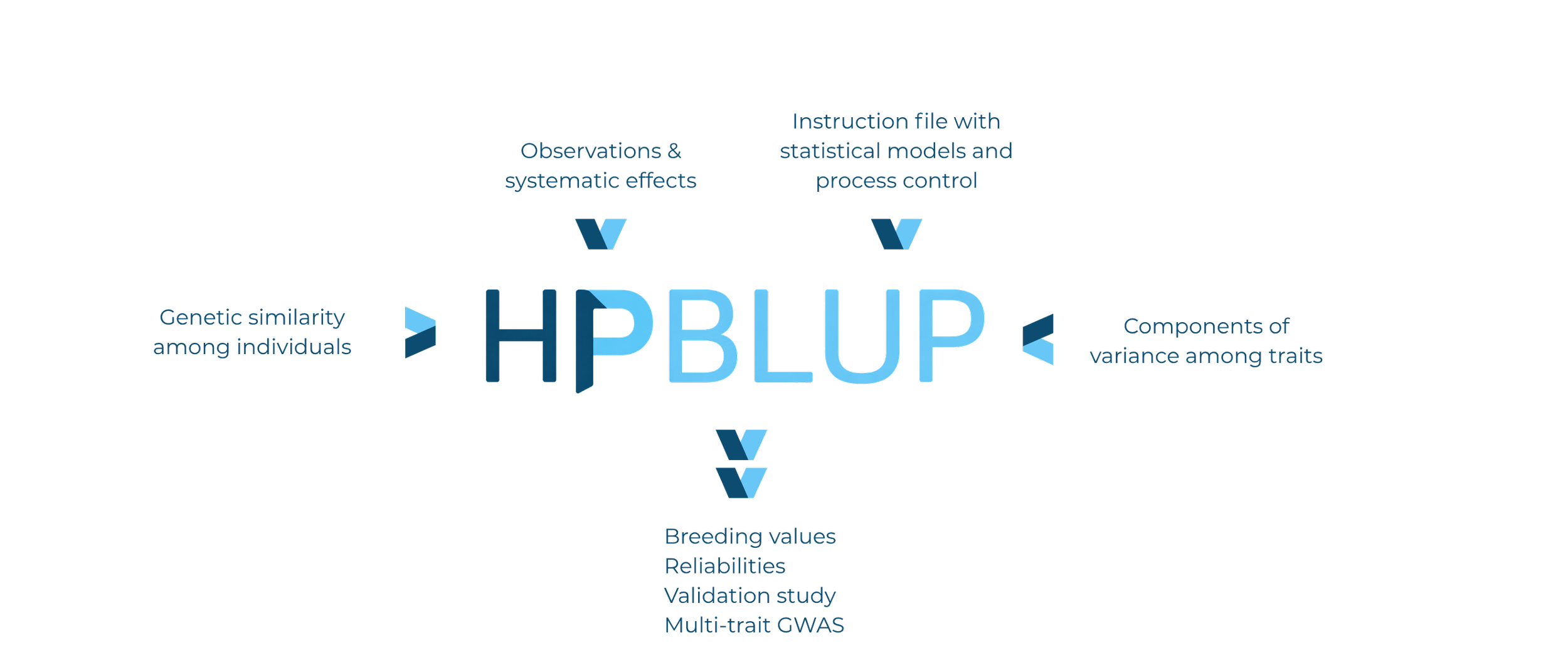
  • Predicted genetic merit
  • Solutions for all model effects
  • Significance of estimated effects of SNP markers
  • Validation statistics

Features

  • Fast
  • Accessible for relatively inexperienced users
  • Suits diploid and polyploid species
  • Handles large populations
  • User friendly interface
  • Meaningful default settings
  • HPBLUP does not require other software to be installed
  • Full functionality available on Linux platforms
  • Not yet available on Windows platforms
  • Includes professional support

Possibilities

  • Data and pedigree may contain numerical as well as alphanumerical data
  • All common formats of genomic information are supported
  • Large datasets
  • Large number of traits
  • Large number of fixed and random effects
  • Individuals with unknown parents can be grouped into a single base population, or in multiple either related or unrelated base populations
  • Indirect genetic effects can be fitted: e.g. maternal or social genetic effects
  • Random regression or reaction norm models
  • Social interaction models
  • Trait-specific models
  • Support for non-additive genetic effects like dominance or epistasis
  • Old solutions can be used as starting values or prior information to accelerate genetic evaluations
  • Multiple genetic and non-genetic random effects with correlated level effects
  • Full support for exact or approximate multi-trait genome-wide association study (GWAS) from the full data
  • User-friendly interface to do a range of validation studies

HPBLUP builds on 15 years  of experience of developing MiXBLUP. Unlike MiXBLUP, HPBLUP does not contain any software components that are developed by LUKE National Resources Institute Finland.